Coming session “Mountain territorial (re)claims. Engaging with indigeneity and autochthonyin a polarized world” at the EASA conference “Anthropology: Possibilities in a Polarised World” in Poznan
Thursday 23 July, 9:00-10:45, 11:30-13:15,
Convenors:
Daniela Salvucci (Free University of Bolzano-Bozen)
Giovanni Masarà (University of St Andrews)
Tobias Boos (Free University Bolzano-Bozen)
Gabriele Orlandi (Université de la Vallée d’Aoste)
Discussant:
Roberta Raffaetà (Ca’ Foscari Venice University)
Mountain areas worldwide are facing new forms of exploitation and extractivism, being perceived as the ultimate reserves of resources, as possible touristic destinations and potential places of refuge from rising temperatures and sprawling metropolises. In response to conflicts, frictions, and polarizations connected to this, people in mountain regions across the world are increasingly (re)claiming territorial belonging and ownership. While some communities demand a political acknowledgement of the value of their local and/or indigenous knowledge(s), some claim to autonomously decide who and how is entitled to manage their own environmental resources or infrastructures, and others are attaching emotional, ethical and identitarian meanings to their context-sensitive, ‘traditional’ practices.
This panel seeks to move beyond the “West and the Rest” framework in discussions of autochthony, indigeneity, localisms, and eco-populist discourses. We aim to examine differences, possible similarities, continuities and discontinuities in how territorial claims and narratives of belonging are articulated in mountain regions globally. While similar dynamics may be found elsewhere, mountains warrant special attention: they have long been imagined, also within anthropology, ethnology and folklore studies, as spaces of difference, Otherness, self-sufficiency, and autochthony. We especially welcome proposals that investigate the social, political, and historical conditions shaping mountain territorial claims, focusing on how these claims may assert boundaries and hierarchies of belonging, and/or cultivate solidaristic and inclusive forms of autonomy and care.
As societies worldwide seem to be increasingly “going indigenous”, we believe anthropologists, ethnologists, folklorists, and montologists are tasked not only with understanding these dynamics but also with finding ways to collaborate with people in mountain regions to co-develop tools and practices for building more just and equitable societies. We are also asking: how can researchers engage with communities navigating the manifold polarising forces related to environmental practices in mountain areas while generating more inclusive, participatory, and plural forms of belonging(s)?
Open Access Special Issue – 2025 – Confluenze. Rivista di Studi Iberoamericani, 17(2)
Relacionalidad medioambiental ritual y festiva en áreas de montaña iberoamericanas
Eds. Tobias Boos, Koen de Munter, Daniela Salvucci
With articles in Spanish, English or Italian written by Denise Y. Arnold, Koen de Munter, Óscar Muñoz Morán, Federica Moscatelli, Francisco Pazzarelli, Daniel González Hernández, Jorge Moreira Peña, Paula Gabriela Nuñez, Letizia Bindi, Ana Correa, Federico Lifschitz, Daniel Darío Delfino, Alejandro Haber, Tobias Boos, and Salvucci Daniela.
Download the open access book following the Link
The archives of the Institute of Aymara Language and Culture, ILCA, in La Paz, are now online, thanks to the sponsorship of the MEAP project (Modern Endangered Archives Program) at the University of California, Los Angeles, USA, with funding from Arcadia
The project “Curation and digitization of the archives of the Institute of Aymara Language and Culture, ILCA” has digitized more than 1,500 data sources that can be used for new research. Access to the trilingual UCLA-MEAP website is free, with entries in Spanish and English, and an extensive use of Aymara. Entries are replicated on the ILCA website (see below). The ILCA archives trace the work of this institution, under the direction of its founder, Professor Juan de Dios Yapita, since the 1970s. It includes 800 audio recordings, newspaper clippings, and other publications covering initiatives of the Indigenous and Indianist Movements of those decades, and books on teaching Aymara language. There is also a photographic and video collection of the ILCA team and of life in the rural areas of the Altiplano and valleys of Bolivia, videos of Professor Yapita’s work teaching Aymara language, and his field notebooks together with those of the British anthropologist, Professor Denise Y. Arnold (with whom he worked from 1985 to 2013). The digitized archive, one of the largest on the Aymara language and culture on the Continent, contains sections on the life and work of Juan de Dios Yapita, including his musical compositions, on life and language use in the marka and ayllus of Qaqachaka, and on the life and political work of the well-known yatiri and midwife Don Domingo Jiménez Aruquipa. Many interviews are conducted with the last generation of monolingual Aymara speakers, in communities in Oruro, northern Potosí, and the lakeside region.
Links: MEAP/ILCANET
Contacts: infoilcabolivia@gmail.com
Denise Y. Arnold
Correo: deniseyarnold@yahoo.com
Cristina Machicado
Correo: machicado.lacris@gmail.com
Open Access Book Publication 2025
Changing Mountain Communities. Between Certainties and Uncertainties
Eds. Tobias Boos, Daniela Salvucci, Pier Paolo Viazzo, Roberta Clara Zanini
With contributions by Laura Bonato, Tobias Boos, Domenico Branca, Elena Cardano, Domenico Maria Costantini, Viviane Cretton, Elisabetta Dall’Ò, Franco Lai, Daniel Maciel, Sofia Marconi, Gabriele Orlandi, Daniela Salvucci, Árpád Töhötöm Szabó, Pier Paolo Viazzo, Sarah H. Whitaker, Roberta Clara Zanini.
Download the open access book following the Link
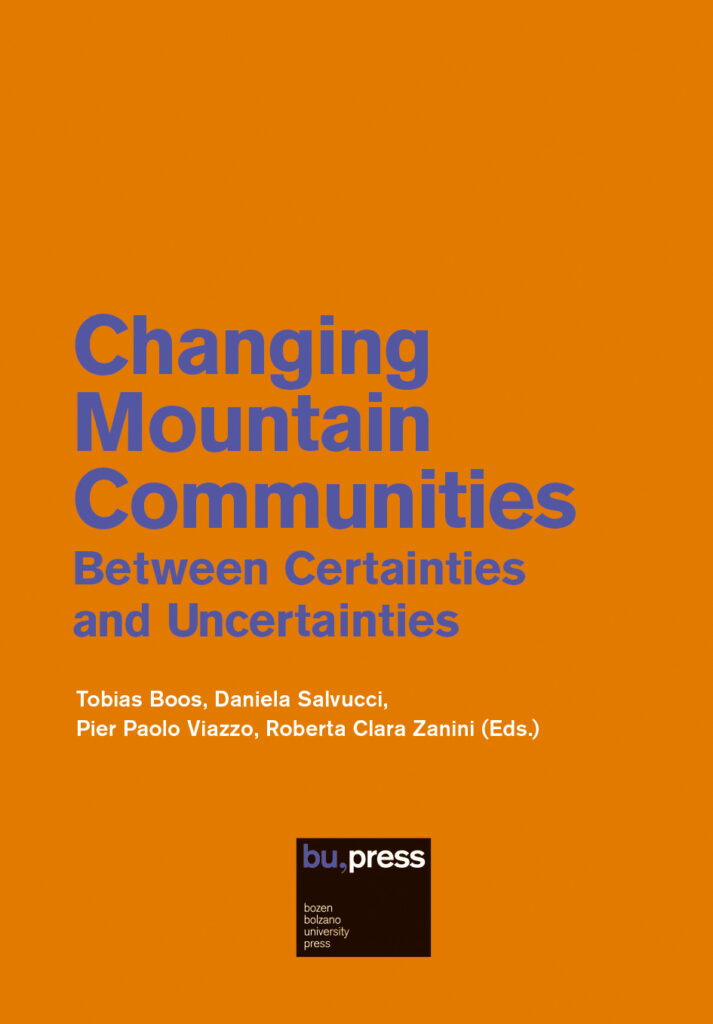
This book examines the complex transformations currently affecting mountain communities. Moving beyond simple narratives of modernization or decline, it highlights the diversity and contradictions displayed by the ways in which these communities experience change – moulded by ongoing negotiations over resources, sustainability, tourism, and heritage. The chapters show that certainties and uncertainties are deeply intertwined in mountain life, often shaping each other in unexpected ways. While climate change has become a certainty, social, economic, and political responses remain uncertain, requiring ongoing experimentation. This tension influences how communities construct identities and traditions, offering both comfort and new challenges as they navigate an unpredictable future.
Through comparative, ethnographic, and anthropological case studies from Europe and South America, the book explores how people and their environments continuously fashion and transform one another amid ecological, economic, and cultural changes. It offers theoretical perspectives for understanding evolving identities, emotions, and the future of mountain societies.