Activities
We organize events, seminars, and excursions on topics related to mountain cultures. We also participate in conferences, congresses, public talks, and festivals organized by other institutes and associations—both academic and non-academic. Through these activities, we aim to foster interdisciplinary and transdisciplinary collaborations.
Participation in PFAM-Piccolo Festival di Antropologia della Montagna 2025, Berceto (24-26 October 2025), organized by Squinterno Festival
Participation in SIAC congress 2025, organized by SIAC – Società Italiana di Antropologia Culturale
Panel 07, Territori, ambienti e speranze cosmopolitiche nelle Americhe, coordinated by Manuela Tassan (Università di Milano – Bicocca), Javier Gonzalez Diez (Università di Torino)
Participation in the IMC-International Mountain Conference 2025
Innsbruck, Austria, 10 – 14 September 2025

Participation in the residential seminar “Salecina Vertical Migrations 2025”, May 22-24, organized by Andrea Membretti and Mafred Perlik, Salecina, Bregaglia/Maloja (Grisons, CH)
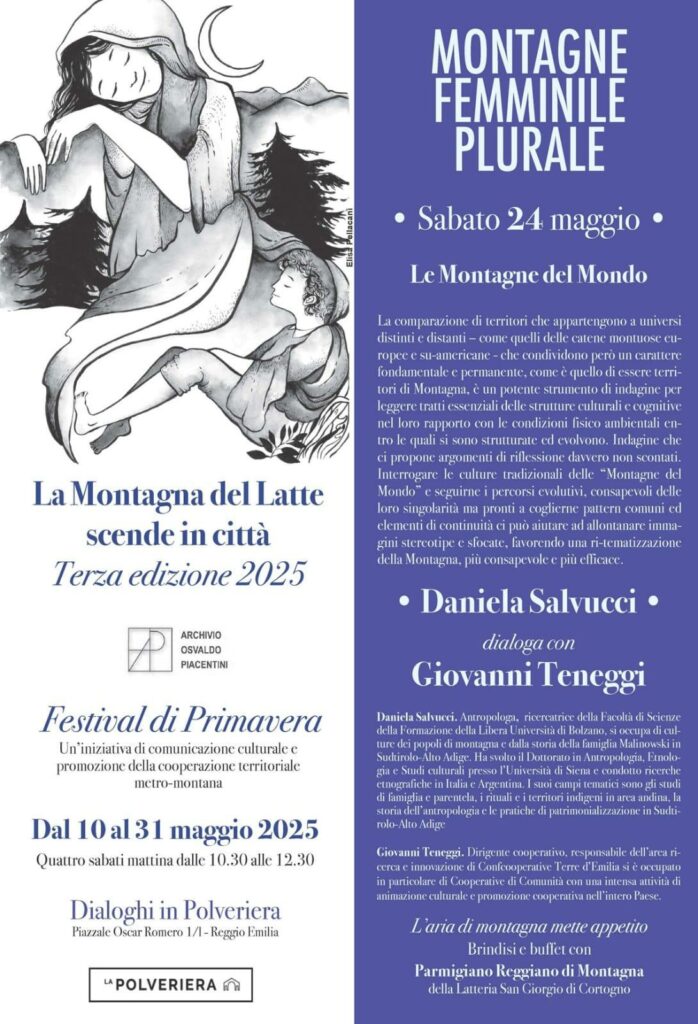
Participation in “Montagne Femminile Plurale”, La Montagna del Latte scende in Città, Festival di Primavera 2025, organized by Archivio Osvaldo Piacentini, Reggio Emilia
Seminar and optional course for students “Changing EUREGIO mountain communities and villages II“, Val di Fiemme, 02-04 April 2025
Organizers:
Angelo Besana, geographer, Department of Literature, Philosophy, Economical-Political Geography, University of Trento
Tobias Boos, geographer, Faculty of Education, Free University Bozen-Bolzano
Nicola Gabellieri, geographer, Department of Literature, Philosophy, Economical-Political Geography, University of Trento
Konrad Kuhn, European Ethnologist, Department of History and European Ethnology, University of Innsbruck
Daniela Salvucci, sociocultural anthropologist, Faculty of Education, Free University Bozen-Bolzano
Guest speakers:
Andrea Bertagnolli, Magnificent Community of the Val di Fiemme
Giancarlo Cescatti, Magnificent Community of the Val di Fiemme
Tommaso Dossi, Magnificent Community of the Val di Fiemme
Mauro Gilmozzi, , Magnificent Community of the Val di Fiemme
Silvia Dalmazzone, Ecological Economist, University of Turin
Andrea Membretti, Sociologist, University of Pavia
Luana Silveri, Ecological Education, Univerity of Groningen
The three-day field trip, including a seminar, took place in the Val di Fiemme (twenty four hours).
The seminar entailed a set of lectures given by invited experts, followed by a practical workshop on geography and anthropology of the Alps.
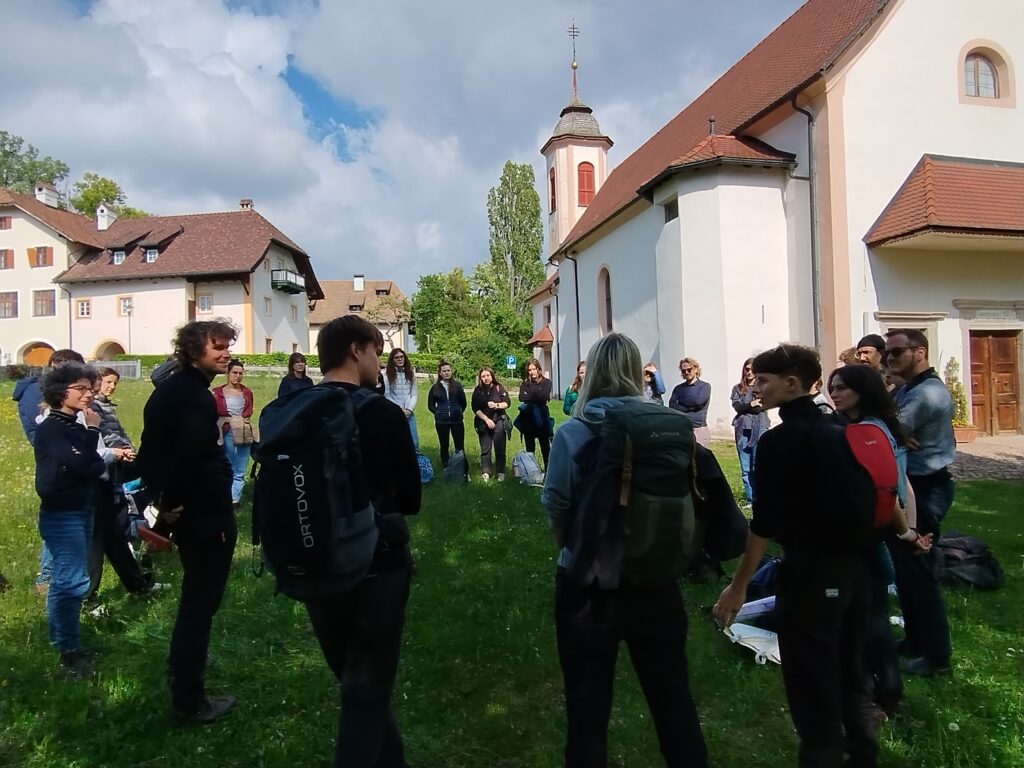
During the field trip in the Val di Fiemme the students, together with the experts and the teachers, explored the historical, sociocultural, economic, and territorial transformations of this area in situ by a guided tour and by applying research methods such as observations, and short interviews. In particular, we intended to consider the case of the old social institution of the “Magnificent Community“. The Community represents a form of collective management of common goods: mountain pastures, meadows and, above all, woods. It has been able to protect and enhance its environmental resources and make the timber trade an important and profitable economic activity for the valley. The main question we addressed in the workshop was: how is this historical form of local institution capable of addressing current environmental challenges?
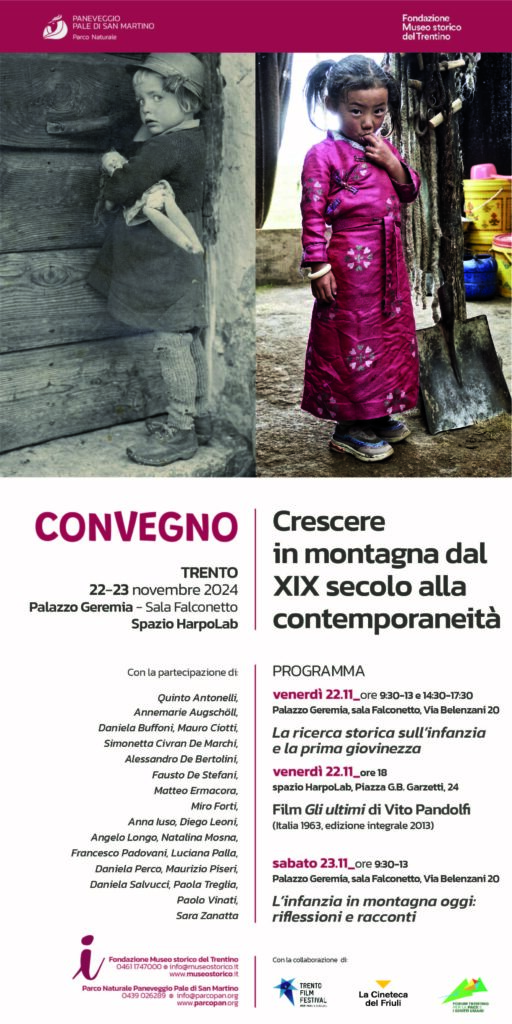
Participation in Crescere in montagna dal XIX secolo alla contemporaneità, Convegno, Trento, 22-23 November 2024, organized by Fondazione Museo storico del Trentino and Parco Naturale Paneveggio Pale di San Martino
Seminar and optional course for students “Changing EUREGIO mountain communities and villages“, Renon/Ritten, South Tyrol, 13-14 May 2024
Organizers:
Angelo Besana, geographer, Department of Literature, Philosophy, Economical-Political Geography, University of Trento
Tobias Boos, geographer, Faculty of Education, Free University Bozen-Bolzano
Nicola Gabellieri, geographer, Department of Literature, Philosophy, Economical-Political Geography, University of Trento
Konrad Kuhn, European Ethnologist, Department of History and European Ethnology, University of Innsbruck
Daniela Salvucci, sociocultural anthropologist, Faculty of Education, Free University Bozen-Bolzano
Guest speakers:
Christian Valtingoier, Forestry of Renon/Ritten
Monika Hellrigl, Tourism Association Ritten/Renon
Peter Righi, Tourism Association Ritten/Renon
Viviane Cretton, Anthropologist, University Western Switzerland
Andreas Haller, Geographer, Austrian Academy of Science, Innsbruck Austria
Silvia Dalmazzone, Ecological Economist, University of Turin
Various academics in anthropology, geography, sociology, and economic sciences point out that communities and villages in the Euregio are characterized by demographic, social and economic changes which are also linked to environmental transformations and crises (e.g., climate, COVID-19). The two-day field trip will focus especially on the interrelation of social changes and environmental crisis, focusing on demographic and economic transformation, migration, tourism, urbanization and social conflicts in Alpine municipalities and villages. These complex processes can be best understood through a multidisciplinary dialogue, in situ research experiences, and by bringing into discussion students from the three universities.
During the two-day course the students got insights into current research from leading experts of the Alpine region, on turistification and landscape changes, on migration and the relation between natural hazards and economic-social transformations, and on the relation between economic and environmental changes. Further, the field trip prepared the students in a practical way to understand, explore and reflect on the complex processes of transformation which occur in Euregio. The students applied the intellectual and practical knowledge, acquired through the course, in their further studies and in future work.
Organization of the event “Making world(s): human, non-human, and more-than-human relationality in mountain areas and beyond,” 14 July 2023, orgnized by unibz
A workshop with Denise Y. Arnold, Oiara Bonilla, Francisco Pazzarelli, Daniela Salvucci, and Federica Toldo. Discussant: Luisa E. Belaúnde
Friday, 14 July 2023, from 15:00 to 18:00, Free University Bozen-Bolzano, Campus Bolzano, room F6, and online in Teams (hybrid)
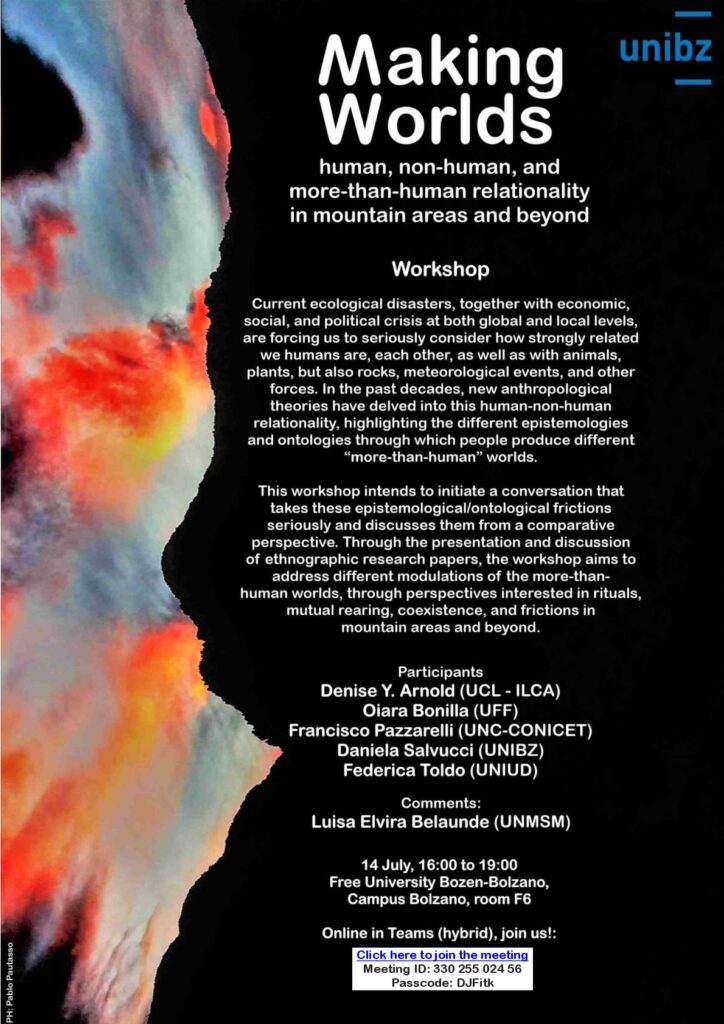
Current ecological disasters, together with economic, social, and political crisis at both global and local levels, are forcing us to seriously consider how strongly related we humans are, each other, as well as with animals, plants, but also rocks, meteorological events, and other forces. In the past decades, new anthropological theories have delved into this human-non-human relationality, highlighting the different epistemologies and ontologies through which people inhabit the world, producing different “more-than-human” worlds. In mountain areas and beyond, the life experiences of people have often been nourished by their relationships with “other” dwelling beings through the grammars of cohabitation, conviviality, and predation. These differences in perspectives and practices of inhabiting the world, or fictions among the diverse worlds, have led to political and social conflicts, for example, those opposing local people to private companies and governments on the management of “natural resources”.
Today, in the midst of the Anthropocene and the ecological crisis, especially indigenous and local peoples, including those living in mountain regions, are being looked at anew, revaluing their productive practices and respect for the “natural” worlds (condensed into extensive pastoralism, for example). However, these perspectives do not always recognize with the same emphasis the “affective”, “ritual” or “religious” dimensions that frame peoples’ relationships with other beings, such as plants and animals, but also rocks or divinities.
Looking at mountain areas, especially in the Andean regions of Bolivia and Argentina (in the cases of Arnold, Pazzarelli and Salvucci), and extending our focus to lowlands (Brazilian Amazonia in the case of Bonilla) and coastal regions (such as the Island of Luanda in Angola, in the case of Toldo), this workshop intends to initiate a conversation that takes these epistemological/ontological frictions seriously and discusses them from a comparative perspective. Through the presentation and discussion of ethnographic research papers, the workshop aims to address different modulations of the more-than-human worlds, through perspectives interested in rituals, mutual rearing, coexistence, and frictions in mountain areas and beyond.
Organization of the panel “Envi04: Changing communities in mountain areas between certainties and uncertainties,” and participation at the SIEF2023 congress, 07-10 June 2023
Masaryk University, Brno, Czech Republic, 08/06/2023
Convenors:
Tobias Boos (Free University Bolzano-Bozen)
Daniela Salvucci (Free University Bolzano-Bozen)
Pier Paolo Viazzo (University of Turin)
Roberta Clara Zanini (University of Turin)
“Change” has been one of the main topics in the study of communities in mountain areas, at least since the 1970s. It has often been understood in relation to modernization, as a linear and irreversible socioeconomical process, leading both to development, from peasant to farming and tourist managers’ communities, for instance, as well as to local decline, abandon, and depopulation. Nevertheless, ethnographic and demographic investigations conducted in Europe in the past few decades have revealed contradictions and variability in change-dynamics, highlighting the impact of recent migration flows, the role of new inhabitants, and the many forms of negotiation on how living together, including different visions and even conflicts on practices of resource management, sustainability, and heritage. Outside Europe, researchers have underlined the emergence of new political, cultural, and ecological awareness of mountain areas’ indigenous people fighting against the environmental exploitation of their territories. All these communities are by no means bounded and isolated entities, but connected at regional, national, and global level. In our current times, marked by multi-crises in politics, global economy and above all climate change these changing communities are facing multiform uncertainties, while sharing at the same time the certainty of permanent and various risks.
In this panel we called for presentations on everyday practices of coping with, resisting, adapting to, interpreting, and framing change and transformation in mountain communities, in Europe and worldwide. It focuses on empirical studies, but also welcomes theoretical and epistemological reflections, within sociocultural sciences and humanities, in comparative, interdisciplinary and transdisciplinary perspective.
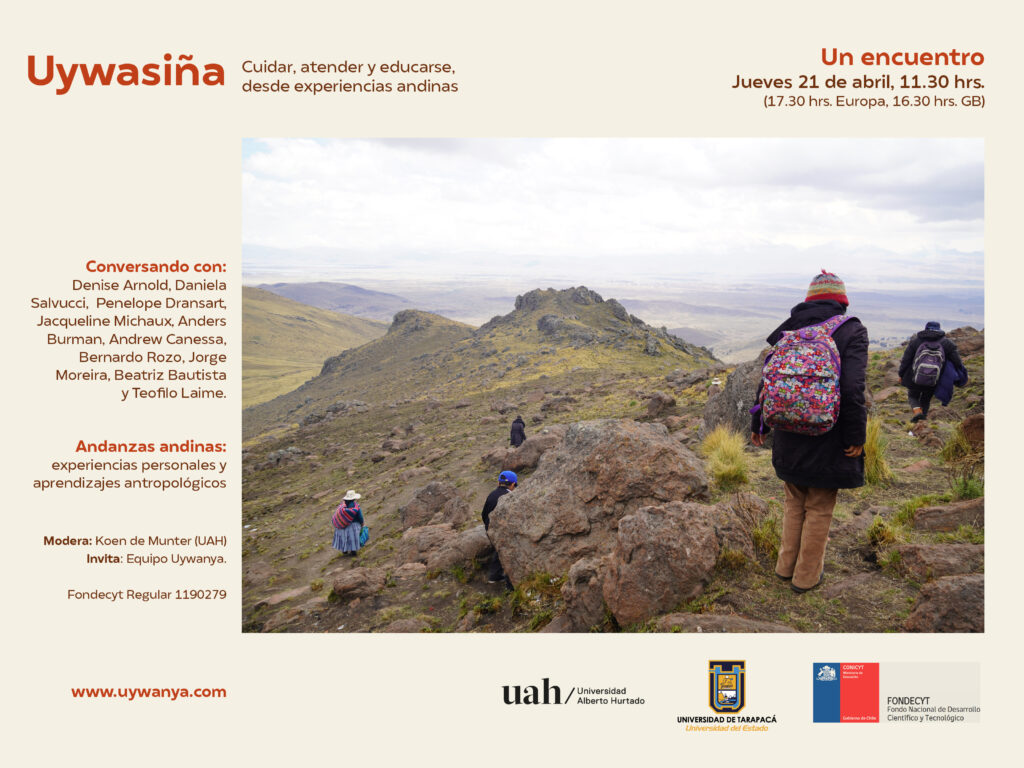
Participation in the event “Uywasiña. Cuidar, atender, educarse, desde experiencias andinas. Un encuentro,” 21 de abril 2022, organizado por el equipo Uywanya, Universidad Alberto Hurtado, Santiago de Chile
Organization of the panel “Rel02 Religiosities as critical moment of alpine “borderscapes”,”and participation at the SIEF2021 congress, 19-24 June 2021
Convenors:
Tobias Boos (Free University Bolzano-Bozen)
Jan-Peter Hartung (University of Goettingen)
Territories between larger political entities (empires, states, …) are prominent stages where forms of conflict between global and local normativities play out, often in a violent fashion. Demarcation of spaces of imperial governance, usually cutting through territories claimed by local communities, come alongside asymmetrical claims of political and cultural representation, in the modern era represented in increasingly strict administrative control mechanisms. High altitude mountains, having often served as natural frontiers, constitute liminal spaces in which these mechanisms are not easily applied, leading to imperial stereotypes of resilient mountain peoples. On a lower order, similar conflict lines run between socio-economic and political elites and subalterns within and between borderland communities, creating thus a thicket of conflictual constellation that is captured in the “borderscape” concept.
We invite papers that focus on the role and scope of religiosities especially in the Tyrolese Alps, the Basque Pyrenees, the Pashtun Hindu Kush and the Kurdish East-Anatolian/West-Iranian Highlands in negotiating conflicting normative claims both inside the communities as well as with the imperial other. We content that religiosities can take the form of distinct, yet contested, cultural heritages and provide thus narratological tools to justify resistance and domination. Hermeneutical core shall thereby be local epistemic forms (as expressed in stories, poetry, …), against privileging interpretative models of the academia of the “Global North”. Moreover, as such investigation necessitates a historical perspective, we call emphatically on historians and literary scholars, to complement Social Science perspectives on the contemporary.
Organization of the Unibz “Seminar Series 2021 Cultures of Mountain People in Comparative Perspectives”
Program / Programma / Programm
14/05/2021, 17:00-19:00, online Le frontiere culturali dell’arco alpino: il caso trentino-tirolese, Giovanni Kezich, Museo degli Usi e Costumi della Gente Trentina INFO
24/06/2021, 17:00-19:00, online Studi transdisciplinari sulle montagne: la prospettiva montologica e l’urbanizzazione andina, Domenico Branca, Institute for Interdisciplinary Mountain Research, Austrian Academy of Sciences INFO
06/07/2021, 17:00-19:00, online Suchbewegungen. Zu Forschungspraxis, Netzwerken und Politiken einer „Volkskunde“ im Alpenraum, Konrad Kuhn, Universität Innsbruck INFO
20/07/2021, 17:00-19:00, online Grenzen und alpine borderscapes, Tobias Boos, unibz INFO
08/09/2021, 15:00-17:00, Bressanone/Brixen Animal rearing, hunting and sacrifice in the high Andes, ancient and modern: a comparative perspective, Denise Arnold, Instituto de Lengua y Cultura Aymara, La Paz, and UCL-University College, London INFO
08/09/2021, 17:00-19:00, Bressanone/Brixen Correspondences between contemporary Aymara and the uywiri-mountains (Bolivia), Koen de Munter, Universidad Alberto Hurtado, Santiago de Chile INFO
07/10/2021, 17:00-19:00, Bressanone/Brixen Le Alpi: bilancio antropologico di due decenni di mutamento, Pier Paolo Viazzo, Università di Torino INFO
08/10/2021, 15:00-17:00, Bressanone/Brixen Forme di organizzazione domestica nelle Alpi: una prospettiva comparativa, Dionigi Albera, CNRS Marsiglia INFO
08/10/2021, 17:00-19:00, Bressanone/Brixen Sacred Mountains. An Exploration in Global History, Jon Mathieu, Universität Luzern INFO
05/11/2021, 17:00-18:30, hybrid, Bressanone/Brixen Growth, relations and movement in the Western Highlands of Papua New Guinea, Almut Schneider, unibz. Discussant: Elisabeth Tauber, unibz INFO
11/11/2021, 17:00-18:30, in presenza, Bressanone/Brixen Politiche strutturali nelle regioni alpine. Qualche racconto da tecnico sul campo, Daniele Ietri, unibz INFO
02/12/2021, 17:00-18:30, ibrido, Bressanone/Brixen Studi di antropologia socioculturale andina e alpina a confronto, Daniela Salvucci, unibz INFO